Where Is the Soviet Plane Flying? Propaganda in Non-Fiction Cinema of the 1920s and 1940s
Aliona Penzii
Researcher at the Dovzhenko Centre,
film critic and cultural manager
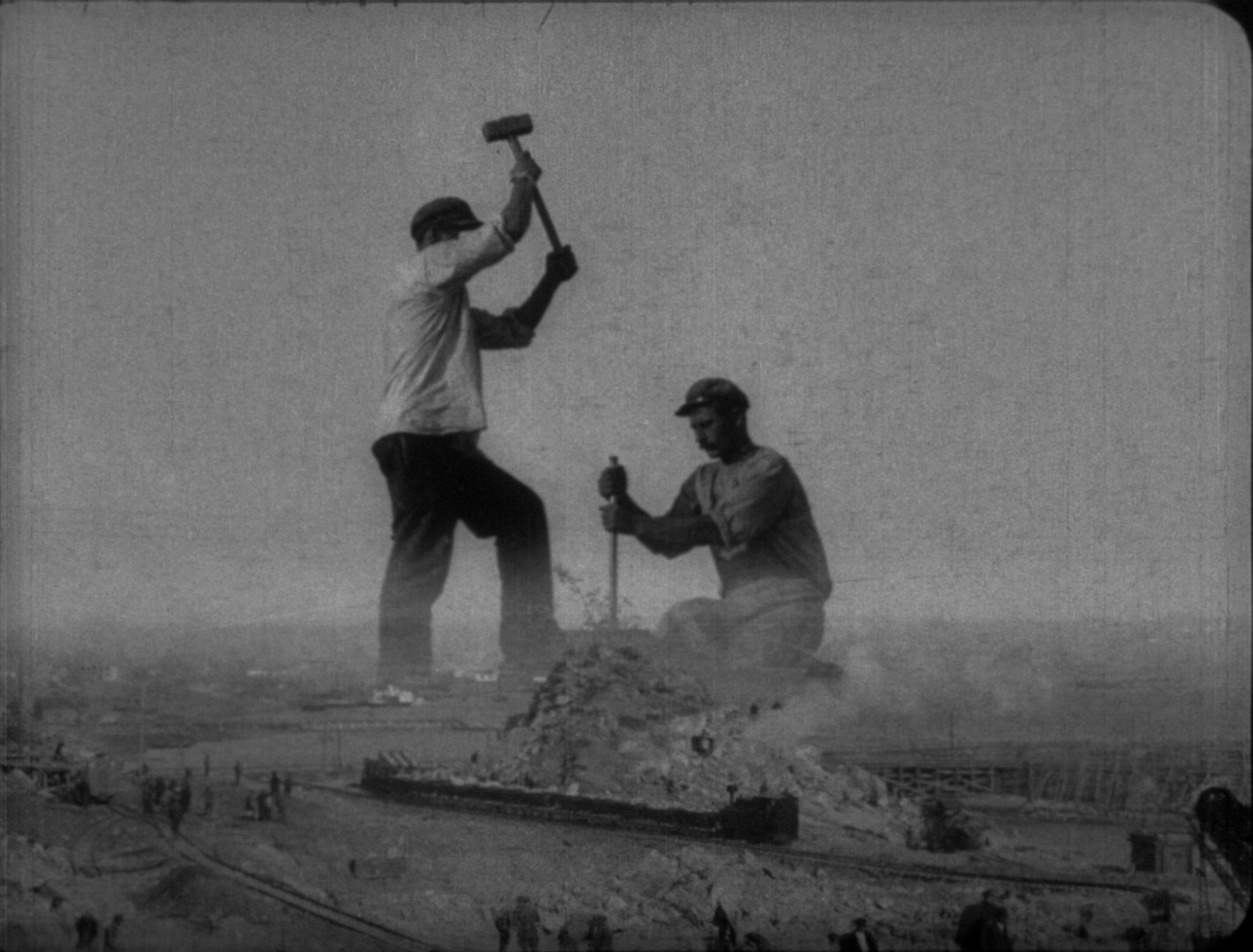
“An explosion. Then another… Stones and sand erupt in a fountain. Fragments fly far over the rails, over the wagons, over the crane. They rattle against the wagon under which we are hiding. They reach the dug-out grave where a Scythian has been lying for 2,000 years now… A Scythian in a grave — and cameraman Kaufman, focusing in astonishment on 2,000 years of silence.” This quote by Dzyga Vertov not only describes the filming process of The Eleventh Year (1928), but also captures the mood of watching the film remarkably well.
This was the first film made by Dzyga Vertov and his team of Kinookos (derived from the Ukrainian words kino — “cinema,” and oko — “eye”) in Ukraine. In 1927, following a conflict with film authorities in Moscow — where repression for “formalism” in art had already begun — they arrived to work at the Odesa Film Studio of the All-Ukrainian Photo and Cinema Administration, abbreviated as VUFKU. In the Ukrainian SSR, the filmmakers were given carte blanche to realise their own vision. This work became the first such radical experiment on the path toward implementing the programme of inventing a pure language of cinema, separate from theatre and literature, in which the camera directly captures the raw material of life. In their practice, the Kinooko group were among the most revolutionary figures of the 1920s avant-garde, and their influence on the subsequent development of non-fiction and experimental cinema can be traced to this day.
In The Eleventh Year, the starting point of the modernisation of the entire Soviet Union is the construction of a hydroelectric power plant in the Ukrainian territory. However, the mechanical “cinematic eye”, in its attempt to capture “life unawares”, records not only the industrial enthusiasm that relentlessly gains momentum, but also the destruction of the Dnipro rapids, villages, and historical landmarks — aspects that are read in a rather critical light today.
All the pathos of industrialisation in the film is directed toward a single abstract goal: “the victory of socialism in our country”, “the victory of socialism in all countries, throughout the world”. This impulse is proclaimed as a collective drive of the entire country, yet it is represented not through the demonstration of masses, but through individualised portraits of people, as if underscoring the importance of each person in this process. In the cosmopolitan tradition typical of the 1920s, the faces that appear on screen include representatives of Africa and India, affirmed in their aspiration to cast off imperialist oppression and move toward socialism. However, in the finale, the result of industrialisation is presented as the military power of the Soviet Union, accompanied by a vigilant, warning gaze directed toward the West — it is somewhere in that direction that Soviet planes are flying.
The image of military aircraft soaring in the sky runs as a recurring motif through the next film in the programme. As one of the protagonists notes: “These are the eagles of Comrade Tymoshenko’s army” — flying to liberate the west of Ukraine and Belarus from Polish oppression. We are referring here to the documentary chronicle Liberation (1940) by Oleksandr Dovzhenko and Yuliia Solntseva, which was intended to “sanctify” the entry of the Red Army into these territories in 1939 following the signing of the Molotov–Ribbentrop Pact.
In 1939, Dovzhenko travelled to the newly annexed territories as part of an official delegation, acting both as a director and a propagandist. At the same time, throughout the entire period of the Second World War, Dzyga Vertov attempted to obtain permission to film at the frontlines, but was instead sent as far east as possible. Neither he nor his brother, cinematographer Mikhail Kaufman, were allowed not only to film, but even to save their mother, who was killed in the ghetto in the city of Bialystok. This city would appear repeatedly in Dovzhenko’s Liberation as part of Poland annexed to the Belarussian SSR.
In his diary entries and private conversations — meticulously recorded in denunciations to the security services — Dovzhenko repeatedly notes the high level of culture and quality of life in the region. Yet on screen, through voice-over narration, editing, and music, he constructs a completely different image: that of a dispossessed and rather primitive population in need of protection and tutelage. According to the film’s narrative, all the actions and thoughts of these people are directed not toward the abstract idea of socialism, but toward a single, very specific and “warm” “friend” and “protector” Joseph Stalin, who is capable of giving liberation.
In this example of non-fiction cinema of the 1940s, there is no longer a place for the cosmopolitan slogans of the 1920s; instead, a narrative of the reunification of brotherly peoples into a single family is clearly and repeatedly reproduced.
At first glance, Dovzhenko creates an exemplary piece of propaganda, yet at the same time — as if deliberately for future generations — he leaves the white threads with which it is stitched. The clothing, facial expressions, and everyday life of the "dispossessed" and “oppressed” do not appear nearly as tragic without the accompanying narration; on the contrary, they suggest a fairly decent standard of living. Enthusiastic crowds move joyfully through city squares, but for some reason are accompanied by a large number of armed soldiers. From the rostrum, fiery yet carefully censored speeches are delivered, while the exalted audiences in different cities appear to be literally identical, repeated exactly.
After the outbreak of the war between Nazi Germany and the Soviet Union, the film effectively disappears from the director’s filmography and from official film studies about him, becoming evidence of an uncomfortable historical period that was subsequently silenced.
Today, however, the film attracts particular interest not only as an understudied part of the artist’s legacy, but above all as material for analysing Russian colonialism in the Soviet period and the propaganda mechanisms that Russia continues to actively employ in its war against Ukraine.
Postal address
© 2025 Arsmediale — Forum of the Experimental Cinema


19/33 Yaroslaviv Val str01034 Kyiv, Ukraine

Where Is the Soviet Plane Flying? Propaganda in Non-Fiction Cinema of the 1920s and 1940s
Aliona Penzii
Researcher at the Dovzhenko Centre,
film critic and cultural manager
“An explosion. Then another… Stones and sand erupt in a fountain. Fragments fly far over the rails, over the wagons, over the crane. They rattle against the wagon under which we are hiding. They reach the dug-out grave where a Scythian has been lying for 2,000 years now… A Scythian in a grave — and cameraman Kaufman, focusing in astonishment on 2,000 years of silence.” This quote by Dzyga Vertov not only describes the filming process of The Eleventh Year (1928), but also captures the mood of watching the film remarkably well.
This was the first film made by Dzyga Vertov and his team of Kinookos (derived from the Ukrainian words kino — “cinema,” and oko — “eye”) in Ukraine. In 1927, following a conflict with film authorities in Moscow — where repression for “formalism” in art had already begun — they arrived to work at the Odesa Film Studio of the All-Ukrainian Photo and Cinema Administration, abbreviated as VUFKU. In the Ukrainian SSR, the filmmakers were given carte blanche to realise their own vision. This work became the first such radical experiment on the path toward implementing the programme of inventing a pure language of cinema, separate from theatre and literature, in which the camera directly captures the raw material of life. In their practice, the Kinooko group were among the most revolutionary figures of the 1920s avant-garde, and their influence on the subsequent development of non-fiction and experimental cinema can be traced to this day.
In The Eleventh Year, the starting point of the modernisation of the entire Soviet Union is the construction of a hydroelectric power plant in the Ukrainian territory. However, the mechanical “cinematic eye”, in its attempt to capture “life unawares”, records not only the industrial enthusiasm that relentlessly gains momentum, but also the destruction of the Dnipro rapids, villages, and historical landmarks — aspects that are read in a rather critical light today.
All the pathos of industrialisation in the film is directed toward a single abstract goal: “the victory of socialism in our country”, “the victory of socialism in all countries, throughout the world”. This impulse is proclaimed as a collective drive of the entire country, yet it is represented not through the demonstration of masses, but through individualised portraits of people, as if underscoring the importance of each person in this process. In the cosmopolitan tradition typical of the 1920s, the faces that appear on screen include representatives of Africa and India, affirmed in their aspiration to cast off imperialist oppression and move toward socialism. However, in the finale, the result of industrialisation is presented as the military power of the Soviet Union, accompanied by a vigilant, warning gaze directed toward the West — it is somewhere in that direction that Soviet planes are flying.
The image of military aircraft soaring in the sky runs as a recurring motif through the next film in the programme. As one of the protagonists notes: “These are the eagles of Comrade Tymoshenko’s army” — flying to liberate the west of Ukraine and Belarus from Polish oppression. We are referring here to the documentary chronicle Liberation (1940) by Oleksandr Dovzhenko and Yuliia Solntseva, which was intended to “sanctify” the entry of the Red Army into these territories in 1939 following the signing of the Molotov–Ribbentrop Pact.
In 1939, Dovzhenko travelled to the newly annexed territories as part of an official delegation, acting both as a director and a propagandist. At the same time, throughout the entire period of the Second World War, Dzyga Vertov attempted to obtain permission to film at the frontlines, but was instead sent as far east as possible. Neither he nor his brother, cinematographer Mikhail Kaufman, were allowed not only to film, but even to save their mother, who was killed in the ghetto in the city of Bialystok. This city would appear repeatedly in Dovzhenko’s Liberation as part of Poland annexed to the Belarussian SSR.
In his diary entries and private conversations — meticulously recorded in denunciations to the security services — Dovzhenko repeatedly notes the high level of culture and quality of life in the region. Yet on screen, through voice-over narration, editing, and music, he constructs a completely different image: that of a dispossessed and rather primitive population in need of protection and tutelage. According to the film’s narrative, all the actions and thoughts of these people are directed not toward the abstract idea of socialism, but toward a single, very specific and “warm” “friend” and “protector” Joseph Stalin, who is capable of giving liberation.
In this example of non-fiction cinema of the 1940s, there is no longer a place for the cosmopolitan slogans of the 1920s; instead, a narrative of the reunification of brotherly peoples into a single family is clearly and repeatedly reproduced.
At first glance, Dovzhenko creates an exemplary piece of propaganda, yet at the same time — as if deliberately for future generations — he leaves the white threads with which it is stitched. The clothing, facial expressions, and everyday life of the "dispossessed" and “oppressed” do not appear nearly as tragic without the accompanying narration; on the contrary, they suggest a fairly decent standard of living. Enthusiastic crowds move joyfully through city squares, but for some reason are accompanied by a large number of armed soldiers. From the rostrum, fiery yet carefully censored speeches are delivered, while the exalted audiences in different cities appear to be literally identical, repeated exactly.
After the outbreak of the war between Nazi Germany and the Soviet Union, the film effectively disappears from the director’s filmography and from official film studies about him, becoming evidence of an uncomfortable historical period that was subsequently silenced.
Today, however, the film attracts particular interest not only as an understudied part of the artist’s legacy, but above all as material for analysing Russian colonialism in the Soviet period and the propaganda mechanisms that Russia continues to actively employ in its war against Ukraine.
Postal address
© 2025 Arsmediale — Forum of the Experimental Cinema
19/33 Yaroslaviv Val str01034 Kyiv, Ukraine


Where Is the Soviet Plane Flying? Propaganda in Non-Fiction Cinema of the 1920s and 1940s
Aliona Penzii
Researcher at the Dovzhenko Centre,
film critic and cultural manager
“An explosion. Then another… Stones and sand erupt in a fountain. Fragments fly far over the rails, over the wagons, over the crane. They rattle against the wagon under which we are hiding. They reach the dug-out grave where a Scythian has been lying for 2,000 years now… A Scythian in a grave — and cameraman Kaufman, focusing in astonishment on 2,000 years of silence.” This quote by Dzyga Vertov not only describes the filming process of The Eleventh Year (1928), but also captures the mood of watching the film remarkably well.
This was the first film made by Dzyga Vertov and his team of Kinookos (derived from the Ukrainian words kino — “cinema,” and oko — “eye”) in Ukraine. In 1927, following a conflict with film authorities in Moscow — where repression for “formalism” in art had already begun — they arrived to work at the Odesa Film Studio of the All-Ukrainian Photo and Cinema Administration, abbreviated as VUFKU. In the Ukrainian SSR, the filmmakers were given carte blanche to realise their own vision. This work became the first such radical experiment on the path toward implementing the programme of inventing a pure language of cinema, separate from theatre and literature, in which the camera directly captures the raw material of life. In their practice, the Kinooko group were among the most revolutionary figures of the 1920s avant-garde, and their influence on the subsequent development of non-fiction and experimental cinema can be traced to this day.
In The Eleventh Year, the starting point of the modernisation of the entire Soviet Union is the construction of a hydroelectric power plant in the Ukrainian territory. However, the mechanical “cinematic eye”, in its attempt to capture “life unawares”, records not only the industrial enthusiasm that relentlessly gains momentum, but also the destruction of the Dnipro rapids, villages, and historical landmarks — aspects that are read in a rather critical light today.
All the pathos of industrialisation in the film is directed toward a single abstract goal: “the victory of socialism in our country”, “the victory of socialism in all countries, throughout the world”. This impulse is proclaimed as a collective drive of the entire country, yet it is represented not through the demonstration of masses, but through individualised portraits of people, as if underscoring the importance of each person in this process. In the cosmopolitan tradition typical of the 1920s, the faces that appear on screen include representatives of Africa and India, affirmed in their aspiration to cast off imperialist oppression and move toward socialism. However, in the finale, the result of industrialisation is presented as the military power of the Soviet Union, accompanied by a vigilant, warning gaze directed toward the West — it is somewhere in that direction that Soviet planes are flying.
The image of military aircraft soaring in the sky runs as a recurring motif through the next film in the programme. As one of the protagonists notes: “These are the eagles of Comrade Tymoshenko’s army” — flying to liberate the west of Ukraine and Belarus from Polish oppression. We are referring here to the documentary chronicle Liberation (1940) by Oleksandr Dovzhenko and Yuliia Solntseva, which was intended to “sanctify” the entry of the Red Army into these territories in 1939 following the signing of the Molotov–Ribbentrop Pact.
In 1939, Dovzhenko travelled to the newly annexed territories as part of an official delegation, acting both as a director and a propagandist. At the same time, throughout the entire period of the Second World War, Dzyga Vertov attempted to obtain permission to film at the frontlines, but was instead sent as far east as possible. Neither he nor his brother, cinematographer Mikhail Kaufman, were allowed not only to film, but even to save their mother, who was killed in the ghetto in the city of Bialystok. This city would appear repeatedly in Dovzhenko’s Liberation as part of Poland annexed to the Belarussian SSR.
In his diary entries and private conversations — meticulously recorded in denunciations to the security services — Dovzhenko repeatedly notes the high level of culture and quality of life in the region. Yet on screen, through voice-over narration, editing, and music, he constructs a completely different image: that of a dispossessed and rather primitive population in need of protection and tutelage. According to the film’s narrative, all the actions and thoughts of these people are directed not toward the abstract idea of socialism, but toward a single, very specific and “warm” “friend” and “protector” Joseph Stalin, who is capable of giving liberation.
In this example of non-fiction cinema of the 1940s, there is no longer a place for the cosmopolitan slogans of the 1920s; instead, a narrative of the reunification of brotherly peoples into a single family is clearly and repeatedly reproduced.
At first glance, Dovzhenko creates an exemplary piece of propaganda, yet at the same time — as if deliberately for future generations — he leaves the white threads with which it is stitched. The clothing, facial expressions, and everyday life of the "dispossessed" and “oppressed” do not appear nearly as tragic without the accompanying narration; on the contrary, they suggest a fairly decent standard of living. Enthusiastic crowds move joyfully through city squares, but for some reason are accompanied by a large number of armed soldiers. From the rostrum, fiery yet carefully censored speeches are delivered, while the exalted audiences in different cities appear to be literally identical, repeated exactly.
After the outbreak of the war between Nazi Germany and the Soviet Union, the film effectively disappears from the director’s filmography and from official film studies about him, becoming evidence of an uncomfortable historical period that was subsequently silenced.
Today, however, the film attracts particular interest not only as an understudied part of the artist’s legacy, but above all as material for analysing Russian colonialism in the Soviet period and the propaganda mechanisms that Russia continues to actively employ in its war against Ukraine.
Postal address
19/33 Yaroslaviv Val str01034 Kyiv, Ukraine
© 2025 Arsmediale — Forum of the Experimental Cinema
